Marketing Campaign Operations Automation System
Project Overview
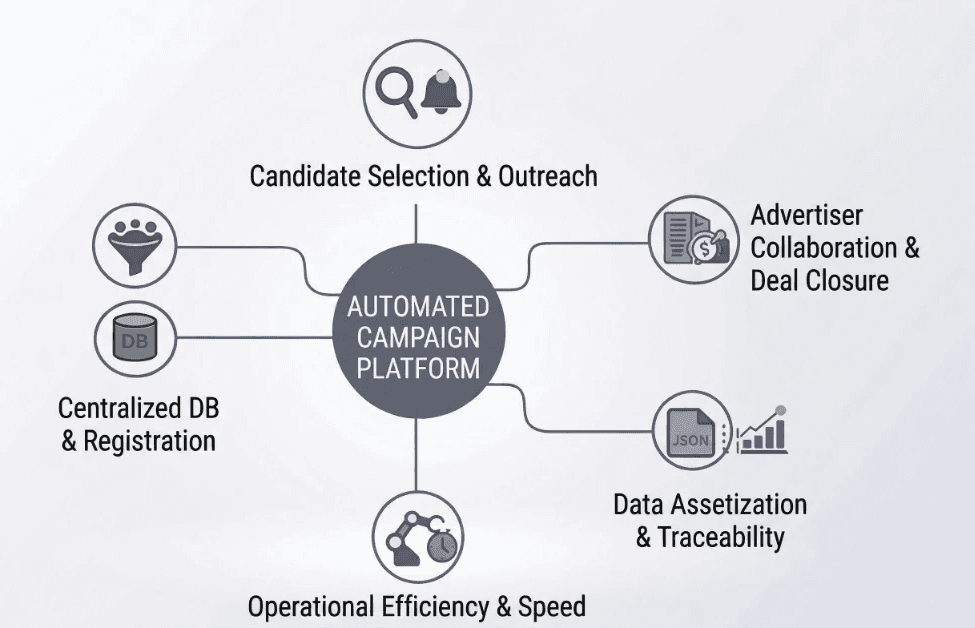
This project is a state-driven, data-based automation system designed to streamline the end-to-end operation of blogger marketing campaigns.
It integrates the entire workflow into a single operational pipeline, covering blogger data registration, campaign creation, initial matching, participation intent collection, advertiser final selection, content submission, and campaign closure.
Previously, operators had to manage blogger data manually and separately track participation requests, response status, final selections, and content submission progress for each campaign. This created a heavy operational burden and made omissions and confusion more likely as campaign complexity increased.
To solve this, the project restructured the workflow into a unified system covering blogger DB creation, campaign registration, candidate selection, notification delivery and response collection, advertiser review, and submission management. This reduced repetitive manual work while improving consistency, visibility, and traceability across campaign operations.
Beyond simple form automation, the system was designed with campaign status-based control, JSON snapshot history retention, separated participation relationship tracking, and rerunnable workflows, making it suitable for stable real-world operations.
Challenges Addressed
Blogger marketing campaigns involve multiple operational steps and stakeholders, including participant management, response collection, advertiser coordination, and submission tracking. When handled manually, inefficiencies accumulate quickly.
Previously, blogger lists, campaign information, participation status, final selections, and upload tracking were managed separately, forcing operators to verify each step manually. This led to repetitive work and made it difficult to manage campaign progress consistently, since outputs from one step were not systematically connected to the next.
There were also limitations when master data changed during operations or when the same process needed to be rerun, especially in preserving the original execution history and reprocessing under the correct conditions.
For this reason, the project aimed not just to automate message delivery, but to establish a state-driven campaign operations framework that could reliably control workflow progress and track results and history at every stage.
Expected Impact and Business Value
Reduced manual workload across blogger campaign operations
Faster and more consistent campaign execution
Conversion of fragmented blogger lists into a structured, reusable master database
Clear traceability through status control, invitation history, JSON snapshots, and upload records
Improved collaboration by extending the workflow to include advertiser-side review and final creator selection