Project Overview
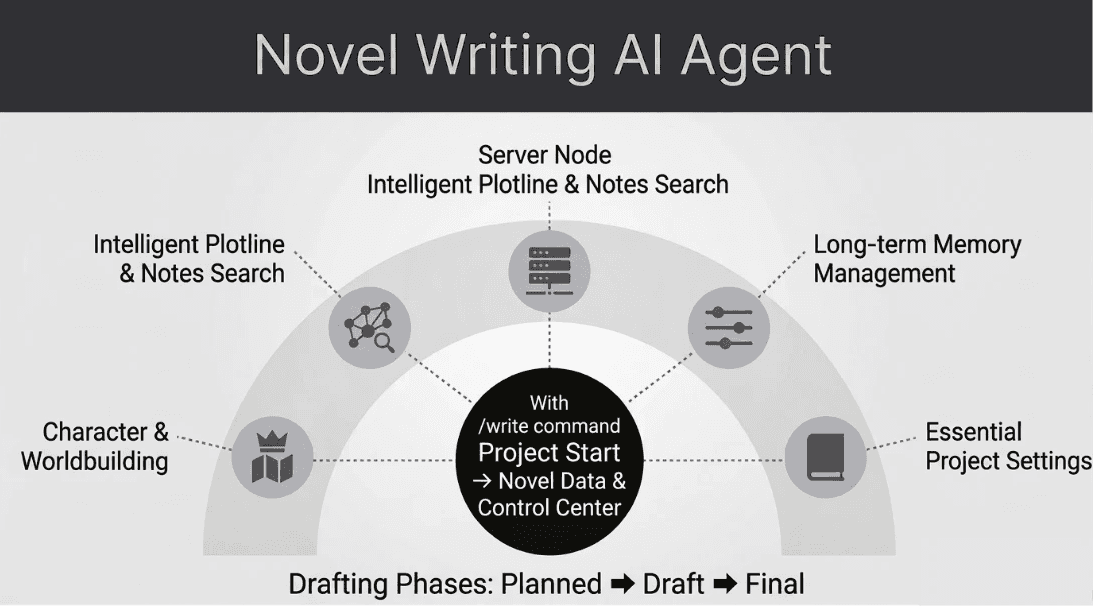
This project is an AI-powered novel writing agent system built to automate repetitive tasks in long-form storytelling, including draft generation, revision, finalization, foreshadowing management, character consistency, and retrieval of context from previous episodes.
Previously, writers had to reread earlier episodes, organize unresolved plot points and foreshadowing, and manually connect the flow into the next chapter. As the number of episodes increased, this created a growing management burden and made it easier for important settings or narrative context to be missed.
To address this, the project restructured the writing workflow into a pipeline covering project creation, state tracking, episode writing, revision, finalization, story memory search, and vector synchronization. This was designed to reduce repetitive management work while improving both continuity and writing efficiency in long-form storytelling.
Beyond a simple text generation tool, the system was designed with a state-driven writing flow, a searchable Story Memory structure, a vector-synchronized long-term memory system, and QA-based operational stabilization, resulting in a sustainable writing automation framework for ongoing use.
Challenges Addressed
Writing a long-form novel is not just about generating one chapter at a time. It is a continuous process that requires connecting past and future episodes, managing foreshadowing and unresolved elements, and maintaining consistency in characters and worldbuilding.
Previously, users had to revisit earlier episodes and manually organize the information they needed. As the story expanded, this increased the management burden and raised the risk of missing important settings or narrative details. In addition, drafting, revision, finalization, and reflection into the next episode were not connected in a single workflow, limiting the practical use of generative AI as a real writing tool.
For this reason, the project was designed not as a simple generative chatbot, but as an operational writing system that manages the long-form writing process through state-based workflows, retrieves and applies prior context, and accumulates long-term memory over time.
Expected Impact and Business Value
The system reduces the repetitive burden of rereading and reorganizing previous episodes, allowing users to focus more on actual storytelling rather than manual story management.
It also enables prior foreshadowing, character settings, and unresolved elements to be retrieved and reflected through search, helping maintain consistency in worldbuilding and narrative structure even as the number of episodes grows.
By connecting drafting, revision, finalization, retrieval, and next-episode reflection into a single workflow, the project extends generative AI beyond one-off text generation into a practical production system for long-form writing.
In addition, through workflow separation by function, state tracking, vector synchronization, and QA-based stabilization, the project establishes a writing automation structure that can be operated continuously in real-world usage.